Ritual Fire from Saint Petersburg
Inside Russia’s Rising Black Metal Vanguard
In-depth interview with Teufelsdom, Russia’s rising Black Metal force. Explore their occult ideology, rapid ascent, ritual sound and underground vision.
Emerging from Saint Petersburg, Russia, Teufelsdom is a contemporary act situated within the burgeoning underground of Black Metal. The band is listed by Encyclopaedia Metallum as an active project from Russia, rooted in the Black Metal genre with stated themes of Satanism, visions and the occult, and operating through the Primitive Devil Worship label. What sets this project apart is not merely geographic or thematic location, but its rapid progression across a clutch of releases in 2024–2025 that have already attracted critical attention.
According to Teufelsdom’s own Bandcamp presence, the project’s discography within roughly two years includes, in chronological order, a 2024 demo, a 2025 demo, a split release in mid-2025, and a full-length album in October 2025. This compressed pace suggests a deliberate, intensive creative burst rather than a tentative early phase. The album itself, bearing the band’s name and released in late 2025, provides a tangible milestone: it encapsulates the project’s musical identity and stakes a claim to longevity beyond the ephemeral demo circuit.
Independent commentary underscores the potency of that first full length. A detailed review from Blessed Altar Zine describes the music as “harsh, raw, yet creative and dynamic, commending distinctive low, chant-like growls, and a production that balances rawness with old-school clarity”. The same review highlights “songwriting that evokes the tension and claustrophobia of the Norwegian second-wave tradition, but without losing its own identity, and praises a surprising yet effective use of piano that intensifies the atmosphere”. Another review platform, Black Metal Archives, lauds the debut as “forged in fire and ice, ritualistic, and dripping with conviction”, even asserting that Russia’s Black Metal scene may have found a new torchbearer.
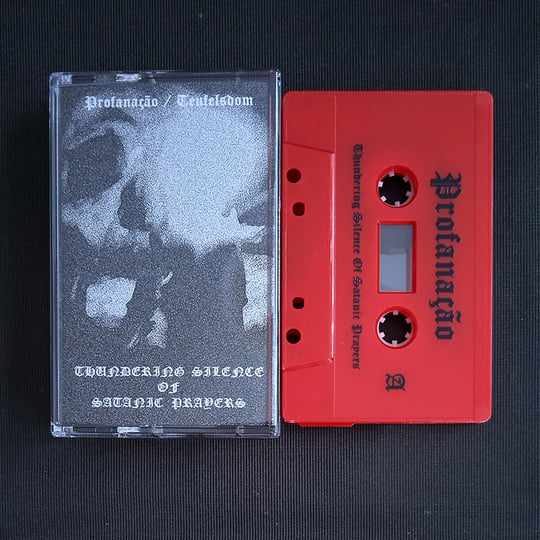
Alongside the album response, the 2025 split with the Portuguese project Profanação, drew enthusiastic commentary in the underground press. Occult Black Metal Zine characterised Teufelsdom’s contributions as “rooted in the 1990s style, mixing slow, mid-paced and fast sections, and maintaining a raw, dark production consistent with old-school satanic Black Metal, ultimately recommending the split to fans of that strain”. Earlier, their 2025 demo was noted for “fast, raw sound, tremolo picking, blast beats, and a blend of pacing that echoes the era it draws from, again signalling a deliberate stylistic homage rather than accidental similarity”.
Taken together, these elements indicate a band that is both deeply indebted to tradition and keenly aware of contemporary underground expectations: rapid output, high-impact atmosphere, and a sound that invites comparison with canonical acts while carving out its own ritualistic space. It is within this tension, between reverence for a historical template and the drive to create something urgent and new, that Teufelsdom’s significance and potential lie.
Given the relatively recent public documentation of the project, what personal or local histories in Saint Petersburg informed the founding of Teufelsdom, and how do these histories manifest in the band’s lyrical or sonic content? In other words, which specific cultural or individual experiences sparked this project’s emergence at this precise moment?
DVLPRST: The idea for the band had been festering for a long time, but what would later become Teufelsdom actually emerged in the second half of 2023. During this time, I increasingly sketched out small ideas, which later evolved into the series of releases you can see now. In large part, this was all made possible thanks to our very close collaboration with VAASAT, which doesn't end with studio work. Shared travels and interests outside of music allow us to develop a better understanding of what we ultimately want to see.
VAASAT: Well, I guess the band emerged because all the circumstances were ripe for it to emerge. Being band mates in another band me and DVLPRST started to spend more time together, sharing our views on both music and ideology and found them quite similar, and since he had an idea of starting a band, one day it came to reality.
Reviews emphasise ties to 1990s Norwegian Black Metal and to raw, old-school aesthetics. How does Teufelsdom consciously balance homage with innovation? To what extent are stylistic choices—such as ominous piano interjections or particular vocal timbres—intended as ritual devices, as experimentation, or simply as a distinct signature?
DVLPRST: I think there are several points that will ultimately answer your question. To do this, it's worth distinguishing between skill in playing musical instruments, a keen ear for music, and a desire to be creative rather than imitative.
The first point is the worst one; unlike my bandmates, I had virtually no experience with music as a musician. Therefore, even over such a short period of time, you can hear significant changes in our discography, both in the complexity of the compositions and in the quality of their execution. The second point is somewhat better, because over the years I've been involved in underground music, I've listened to many different bands. I also have a certain interest in ethnic and classical music. Thirdly, from the very beginning, the main goal was creativity, not the desire to be like Band A or Band B. Otherwise, I believe it would be a profanation and a mockery of the very essence of art.
What do we have in the end? No longer young and a poor instrument player, but with an understanding of music from other perspectives, he begins to actively engage in creative work, framing his thoughts in the melodies that arise in his head.
This is where certain experiments come from. They are tools that allow us to act in the moment. For example, I've seen the appearance of the piano on our first album highlighted several times. It arose in the moment and was cemented in the recording; it wasn't even ours, it was simply sitting in our old rehearsal room. When we tried playing it, we realized it was the sound we needed for the atmosphere of Adamas Ater. Does this mean you'll now hear piano regularly in our recordings? Definitely not.
VAASAT: Unlike DVLPRST, I spent quite a few years playing music, and that gave me some kind of a skill. On the other hand I haven't been listening to music much, so I definitely cannot boast to be a Black Metal encyclopedia. So, basically our background is quite different. But I guess we share the same opinion. And it is that there is only one thing standing behind the word “tradition” when it comes to Black Metal. And that very one thing is Satanism, which may be expressed differently in terms of music. So we use all means that may help us to express our ideology in music.
The band is listed with themes of Satanism, visions, and occultism. Beyond the textual labels, how does Teufelsdom interpret these concepts in practice? Are they invoked primarily for atmospheric effect, for a philosophical or esoteric program, or perhaps as a critique of contemporary cultural or spiritual climates?
DVLPRST: Through the prism of visions and ritual work, a concentrated energy is created, embodied in uncomfortable lyrics and edgy melodies. We don't create atmosphere for the sake of atmosphere, but rather are conduits for the forces that resonate with us. These are dark and gloomy moods.
VAASAT: All the music is en expression of our everyday experience, spiritual and ritual. Practice what you preach.
The 2025 split with a Portuguese project signals a willingness to engage beyond national borders. Does Teufelsdom view such collaborations as a form of occult networking, ideological solidarity, or purely musical synergy? How might this global engagement shape future aesthetics or distribution strategies, especially when considering the peculiarities of the Russian underground and international label partnerships?
DVLPRST: The musical component is certainly important, but in the context of what you're asking, it's secondary. First and foremost, of course, is ideological solidarity. We may all have different views, but there's always one common denominator: a belief in Something Dark, Powerful, and Cruel that stands above us all - the Devil. And here, the particular practice the practitioner has embraced isn't so important: it could be Quimbanda, Chaos, or more sophisticated movements. I've always had an interest in establishing contacts, particularly international ones. This manifests itself both within Teufelsdom and in the activities of my label. As a friend of mine said, "spirits know no borders or passports." None of this can influence our aesthetics in any way, because what we do comes first and foremost from the depths within us and the fire we fan within ourselves.
VAASAT: Very well said! Truly it is an occult networking, ideological solidarity, and purely musical synergy. And I wouldn't separate them. These three are like three sharp points of an unholy trident, which can blow the earth like an air balloon.
The sequence from 2024 demo to 2025 album shows rapid output. What internal or external criteria determine when a new composition is a demo, a split, or an album track? How might the intensity and rawness present in early demos evolve in subsequent full-lengths, and what would constitute a deliberate stylistic shift versus a maturation of the same core vision?
DVLPRST: Firstly, a multitude of ideas and the opportunity to realize them came together. As I said in answer to another question, I don't consider myself a musician, let alone a good one. So, for a number of reasons, I use music as a means to materialize certain ideas.
This approach frees you up and allows you to avoid feeling like a hypocrite. On each of our releases, we allowed ourselves a certain amount of freedom to improvise, make mistakes, and maneuver in order to create our own unique and personally meaningful experience. This is priceless. We would have been depriving ourselves of this if we had delegated some of the stages along the way to others.
In this short time, we've worked with various release concepts: we gained experience recording demos, participated in an international split with our brothers from Profanacão, and recorded a full-length album. Each had its own nuances and circumstances. First of all, all the songs are conceptually interconnected. You can find this on the album. You can find it on our side of the split. You'll find this on the split, where we coordinated the concept of the future work with the guys.
The recording and mixing methods also changed on these releases as we gained not only experience but also the necessary equipment. We learned to play with it. For example, during the first recording, we recorded the drums with a single condenser microphone positioned in the middle of the room. This produced a unique sound that sets this recording apart from our others with its distinctive metallic drum flavor. On the second song on the split, we decided to use drum improvisation, inspired by Iron Butterfly's 1968 song "In-A-Gadda-Da-Vida." I told VAASAT back then that I don't remember a single Black Metal song where the drum solo was a full-fledged part of the composition, and when he heard the solo, his first question was, "What the hell is that?!" But ultimately, it resulted in a unique composition that combines classic Black Metal cues while also briefly stepping outside of them, eventually returning to them. That's our style.
Reviewers note a production that is simultaneously raw and crisply old-school. How intentional is this mix? Does the band view its production choices as part of a ritual toolset, invoking a specific psychological state in listeners, or as an aesthetic continuum inherited from historical precedents? What might be the psychological or occult logic behind the decision to incorporate, for example, sudden piano sequences in predominantly aggressive compositions?
DVLPRST: When choosing a sound, we are primarily guided by our own sensations. In this sense, we are not only the authors and performers, but also the first test subjects to hear these words and melodies, and we note how our minds and bodies react. Through a cycle of experimentation, we create our own sound.
As for the abrupt transitions and insertions, I simply like them. I love the strange, including within compositions. He whose name must no longer be spoken in our country is rightfully considered the king of lies. Such deceptive moves that offer false hope and peace can easily be crushed by the onslaught of the melodies that follow. This is also interpreted as the destruction of the fragile, tender, and sublime elements upper that wild, primordial Darkness.
Reviewers and underground zines have reacted enthusiastically, yet public awareness remains limited. How does Teufelsdom perceive its audience? Is there a target listener beyond the committed underground fan, or does the band aim to cultivate a narrower, more devoted circle? What does success mean within a scene that often prizes obscurity and authenticity over mass recognition?
DVLPRST: Honestly, I don't think about it. Everything we do is primarily for ourselves. Let's think about it: I understand that by exposing our audience, they become somewhat open. I don't think it's possible to adequately filter your listeners. Breaking out of the underground requires not only brilliant music, but also, most importantly, increased media exposure and financial investment. We don't strive for that, so Teufelsdom is a beast within the underground and is intended for that audience.
VAASAT: We don't strive for mass recognition or fame. If someone finds our music and lyrics consonant with their views, that is wonderful. If there is just one person, its fine. If there is one million of them, it's very good, that means we have many brothers and sisters in arms.
With claims of torchbearing for Russian Black Metal, how do band members envision their long-term legacy? Will they pursue a path of continuous rapid output, seek greater sonic complexity, or perhaps engage more overtly with regional folklore or historical narratives? How might future works redefine or solidify the band’s place in the broader Black Metal canon?
DVLPRST: We'll do what's necessary for as long as it takes. It's foolish to think too far ahead when it's unclear what the world will be like in the future and whether we'll be allowed to live in it any longer. Nevertheless, we're focusing on the present in order to move toward the future. As of December 2025, we have completed recordings for two splits in 2026, a fully composed second full-length album, which we plan to begin recording in January, just a week from now, and a whole host of unsorted pieces. We're also holding extended weekly rehearsals (yes, we've been a trio for several months now) to prepare for our first show next year.
As our skills improve, I think we'll allow ourselves some experimentation, but we don't plan to stray beyond the genre's boundaries. The same can be said for the lyrical content of our compositions. If on the first album most of the lyrics were dedicated to Visions, then on the second album it will be an understanding of the process of dying and the theme of Death in general.

Teufelsdom sits at an intriguing nexus of rapid creative momentum and deliberate stylistic fidelity. In barely two years, the project has constructed a discography that touches on crucial modes of underground Black Metal: demo rawness, collaborative split ritual, and a full-length that commands critical attention. Independent reviewers not only praise technical and atmospheric elements, vocals, production, pacing, and the surprising use of piano, but also situate the band within a lineage that emphasises tension, claustrophobia, and ritualistic conviction. Such responses serve both as validation and as a challenge: Teufelsdom has clearly demonstrated its capacity to evoke powerful moods, yet the very intensity of early praise raises questions about sustainability, evolution, and the potential for deeper philosophical exploration.
The band’s declared thematic concerns, Satanism, visions, occultism, are not unique within Black Metal, but the manner in which they are entwined with fast, raw riffing, measured pacing, and articulate production suggests an ambition to transcend mere genre replication. The distinctively Russian provenance adds further complexity: Saint Petersburg’s cultural and historical layers, combined with the global underground’s transnational dialogues, create fertile ground for both reaffirmation of tradition and the gestation of new forms.
Ultimately, Teufelsdom’s story so far, invites scrutiny not only of musical texture, but of cultural positioning, symbolic intent, and future direction. It compels listeners, critics and potential interviewers to watch closely: will the band continue to refine a powerful, emerging identity within the underground, or will its next steps redefine what Russian Black Metal can be? Only sustained engagement with their evolving output can answer this, but the early signals are emphatic: here is a project intent on forging its own ritual fire and demanding that the wider scene take serious notice.
Comentários
Enviar um comentário