
Ultra Silvam Interview – Ritual, Chaos and the Living Myth of Swedish Black Metal
An in-depth interview with Ultra Silvam on ritual, chaos, satanic ethos and the future of Swedish Black Metal. Exclusive underground insight.
Band: Ultra Silvam
Origin: Malmö, Sweden
Style: Orthodox / Ritual Black Metal
Albums: "The Spearwound Salvation", "The Sanctity of Death"
From the shadows of Malmö, Sweden, emerges Ultra Silvam, a force of Black Metal that is both primitive in execution and esoteric in meaning. Since their inception, they have embraced the ethos of violent, uncompromising sound, yet have also carved a path marked by ritualistic depth and mythological resonance. Their music is not simply performance, it is an invocation, a sanctified act of desecration, where each riff and lyric is a weapon in the war against spiritual complacency.
Across releases such as “The Spearwound Salvation” and “The Sanctity of Death”, Ultra Silvam have established themselves as more than a mere band. They are narrators of an inverted liturgy, architects of ritual, and vessels of a symbolic language that invokes decay, transcendence, and confrontation with the divine. Their art carries a brutal immediacy, yet also a long shadow, a mythos unfolding track by track, album by album, in a cycle of Death and renewal.
With the world of Black Metal in constant flux, Ultra Silvam stand as torchbearers of something ancient and uncompromising, while simultaneously constructing new pathways through myth and symbol. As they prepare to descend upon audiences at the Invicta Requiem Mass in Portugal, their presence raises urgent questions: What does Ultra Silvam embody today? What myths are they conjuring into existence? And how do their hymns of Death and liberation connect with the shifting currents of the underground?
The following questions seek to unravel these mysteries, delving into the band’s inspirations, their lyrical codes, and their reflections on Black Metal’s past, present, and future.
Ultra Silvam emerged from Sweden’s fertile underground yet carries a raw intensity distinct from the country’s more polished Black Metal traditions. How did the band’s identity take form, and what philosophies bind you together?
Around 2015/2016 we started this band with the main intent to create proper Black Metal mayhem in total alignment with all the foundations and essentials that this style is dependent on. The state of the genre at that time definitely helped us steer even more in the right direction as it could also be seen as counterculture to all the paradoxical life metal bands masquerading their music as Black Metal while embracing atheistic “world views” and forcing political, wordly nonsense in your face and whatnot. Ultra Silvam has nothing to do with what I just mentioned and solely exists to channel primal, satanic energy in all forms that we deem fitting and on the very same foundations we still stand today, ten years later.
From the beginning, your music has carried a sense of urgency, even violence, in its execution. Is this aggression primarily musical, spiritual, or both?
Like I mentioned before, the very spiritual base that this band is resting on can be channelled through various means as it’s an endless source. We’ve just decided to focus on the more destructive elements of it as it corresponds well with our musical ambitions/abilities and as long as it gets my cock hard and we’re able to keep doing that with the same impact as when we started, we’ll continue to do it.
Black Metal, especially in its purest forms, often balances between chaos and order, destruction and revelation. Where do you situate Ultra Silvam within this spectrum?
There are always dualities and a point of balance that’s desirable, though in the contexts you mention Ultra Silvam lean more heavily towards the chaotic and destructive one thematically. Musically though there are glimpses of its counterpart every now and then though, I don’t want either to take over completely as that’s not really the way I want to see this band develop.
Many describe your work as liturgical in nature, like a corrupted mass. Do you see your performances as ritual, and if so, to whom or to what are these rites directed?
Technically you could say it is, but I don’t call it that. I’m very keen on keeping the METAL part in Black Metal and not get too carried away, I’d rather let proper academics handle that part as we’re not part of a “clergy” in a metaphorical sense, but rather individual practitioners. I’d never argue that what I have to say through the music/lyrics can be seen as a message of any sorts, it’s just words of a madman that people can interpret as they wish, though if it would help grow some sort of spiritual awareness or inspiration, I’m the last one to complain.
In an era where Black Metal is increasingly diverse and fragmented, what does it mean to remain faithful to the genre’s primitive roots?
If you mean “primitive roots” as in satanic, loud and over the top then I don’t see any other way of doing it so I can’t answer that since I’ve not been on the “other side”.
Do you see today’s Black Metal scene as a continuation of the movement’s original rebellion, or has it become something entirely different?
Definitely. Bands not doing that are not playing Black Metal whether or not they claim to in my opinion so it’s completely irrelevant then.
With festivals like Invicta Requiem Mass bringing together acts from across the world, do you believe the Black Metal community is becoming more universal, or does the genre still rely on local identities?
No idea, I barely know anyone in my local area that listens to Black Metal outside of the people I play in bands with, so I don’t belong in any community or things like that.
Across your two albums, sacred imagery is constantly inverted: bread becomes mould, wine becomes rot, sanctity becomes Death. Do you see your lyrics as symbolic inversions of Christian ritual, or as attempts to forge a parallel mythos altogether?
That’s definitely a red thread for sure now that you mention it. Nothing is black and white though in the very beginning of Ultra Silvam we were very insistent on focusing on using the judeo-christian pantheon as a base rather than dipping our toes in pagan territory. I can’t exactly point to what’s the exact reason but it’s rather a vague feeling of how we want our Black Metal to be represented, it definitely feels closer to home as we’re steeped in that world view, despite living in one of the most secular countries in the world, you can’t ignore the roots of where it stands.
Your lyrics often use archaic phrasing, almost liturgical in cadence. How important is ritualistic language itself in summoning the atmosphere of Ultra Silvam?
It definitely is if you compare it to Saxon, though there are definitely bands that do that much more than us. Like mentioned previously, keeping a steady connection to heavy metal is super important and I’m always balancing between the primitive “meat and potato”-mentality of metal music and the religious, otherworldly side, both which when combined becomes Black Metal.
Anyhow, to answer your question the lyrics are far from what you might see with certain bands where their lyrics can feel like something straight out from a grimoire rather than personal reflections of spiritual encounters and insight. Ultra Silvam adheres to the latter and it’s just my fuckedup mind opening and I don’t expect anyone to understand it and that’s fine, but I think I touched upon that earlier.
“Tintinnabuli Diaboli”, from “The Sanctity of Death” carries the resonance of ritual bells, an ominous tolling. Can you unravel the symbolic intent of this track and its place in the album’s narrative?
It was a title that the guitarist Olle came to me with. I don’t know where he got it from but in one way or another that track was composed.
“Dies Irae” invokes one of Christianity’s most apocalyptic hymns, but through your lens it becomes something darker and liberating. What does this reinterpretation of judgment day signify in Ultra Silvam’s worldview?
Pure fucking armageddon, it’s fucking cool and does not need much more explanation.
Each Ultra Silvam release feels like a self-contained mythic cycle, a descent, confrontation, and transformation. Do you deliberately construct albums as episodic myths, or do they emerge organically from the writing process?
No, they are not concept albums at all. From the days of our demo to our last album, I reckon any of these songs could fit on the same album as they are all steeped in the same essence, just different aspects of it (most of them). I don’t believe Ultra Silvam will ever make a concept album either as the creative process is too chaotic for that so I can’t see that happening.
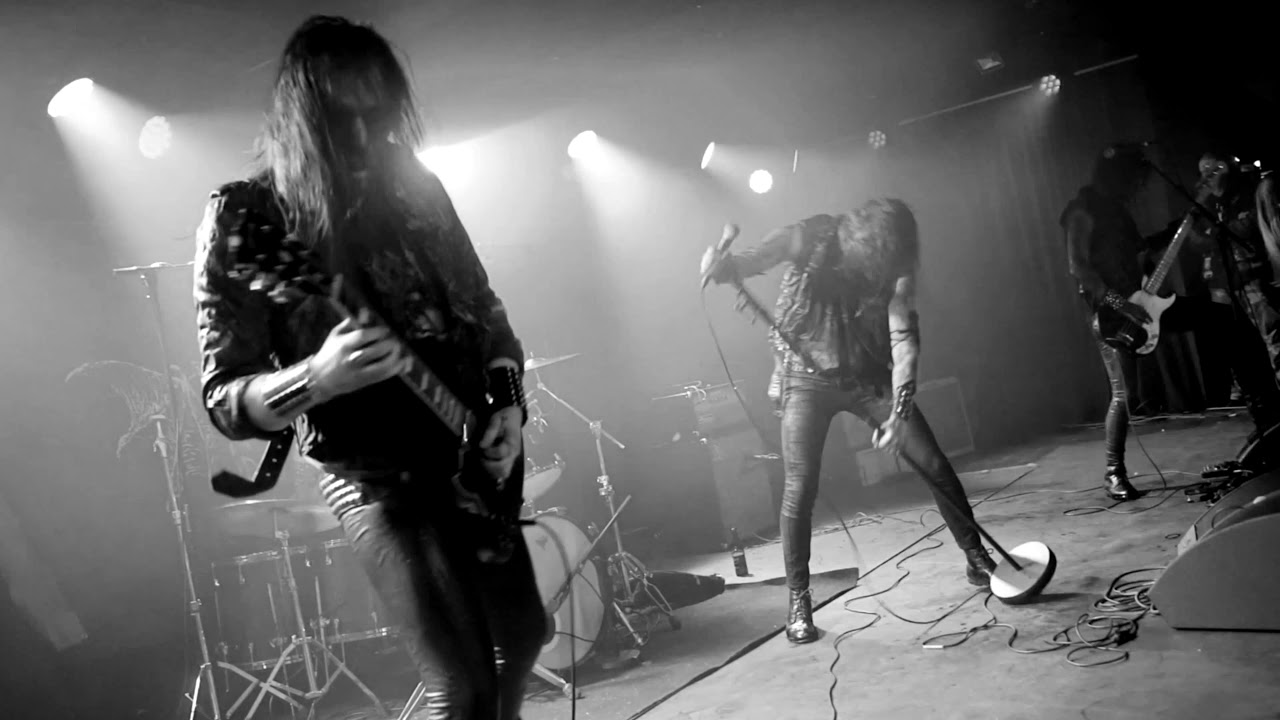
Ultra Silvam’s live performances are marked by intensity and austerity, no theatrics, just raw power. What is your philosophy when it comes to translating your music onto the stage?
I fucking hate 99% of all metal shows I see as it lacks the energy. Sure, it’s important to play correct, conserve energy and whatever but personally I feel full responsibility to go all out as far as my human frame can go without completely breaking down. I’ve always seen us as a punk band in that sense, those are mainly the only shows that give me something and you learn from that and we just do it in a Black Metal context. Energy over precision always.
Do you perceive live ritual as a form of communion with the audience, or as an act of separation, creating a boundary between performer and observer?
Rarely as all the mundane irritations like shitty situations, technical mishaps and whatnot works like a cosmic finger up your arse and reminds you that you are a filthy human being. When you manage to overcome that though and hit the sweet spot it all makes sense. I can’t see it as a guarantee though when you’re an underground band that needs to rely on dodgy equipment and backstage areas that more resembles a cleaning closet, but it is what it is and what can you do?
Looking at the wider cultural landscape, do you think Black Metal can still shock, provoke, or spiritually awaken in the way it once did, or has its role changed?
The more “artificial” aspects of it can definitely do as I have seen people from the crowd faint, vomit, cry and react in pure disgust and act like offended cry babies having some delusional idea that they know what it’s about when in reality they are about as tough as the Teletubbies. For the religious parts, to truly chock or turn people’s heads inside out it’s probably very hard in this secular shithole of the world, and the people who openly follow the right-hand path I don’t think would consume us anyway, so I have a hard time seeing that happen.
Ultra Silvam stands at the intersection of tradition and innovation. How do you intend to carry your flame forward without letting it be diluted by trends or commercialism?
Thank you, that sounds like something I’d strive for! That should not be any problem as I’m living under a rock as it is and it’s hard to be influenced by current trends when you don’t come in contact with them so I’m positive it’s gonna continue just fine.
When the future looks back on Ultra Silvam, what do you hope your music will signify within the greater chronicle of Black Metal?
If the world still stands in a hundred years and there is just one person discovering Ultra Silvam and getting the same out of it as I did with Mayhem back when I was a kid, then I can’t complain at all. If it doesn’t, well it’s filled my life with further meaningfulness so it’s good either way.
Ultra Silvam are not merely participants in the Black Metal tradition, they are sculptors of its ongoing myth. Their music does not soothe; it desecrates. It does not entertain; it convicts. Within their hymns lie ancient symbols inverted and reborn, each song another chapter in a grim liturgy written against the silence of a world in decline.
After they summoned darkness at Invicta Requiem Mass in Portugal, the band stands poised between past and future, holding fast to the primordial violence of Black Metal’s essence while forging new allegories through sound and symbol. Whether through the tolling bells of “Tintinnabuli Diaboli”, the grotesque sacrament of “Of Molded Bread and Rotten Wine”, or the apocalyptic liberation of “Dies Irae”, Ultra Silvam continue to create a body of work that feels both timeless and immediate, both archaic and prophetic.
To engage with Ultra Silvam is to confront Black Metal not as a genre, but as a living myth, a force that will continue to evolve, desecrate, and illuminate in cycles yet to come.
Comentários
Enviar um comentário