
Forging Epic Tapestries in Black Metal’s New Dawn
In the snow-hung forests of Finland, where legend and iron-forged myth intertwine, emerges one of the freshest voices in extreme music: Bronze Hall. Though the project is in its infancy — officially formed in 2025 — it has already made a profound impact within the Black Metal underground. At its core stands Yöpyöveli, a solitary architect of sound whose creative reach extends from the vocals and instrumentation to recording and mixing itself. The result is music that feels less like a collection of songs and more like a chronicle of ancient sagas transposed into primordial audio.
Bronze Hall’s sound positions itself firmly within Epic Black Metal, a realm where tempestuous riffs crash against wide-open melodies, lavish atmosphere meets frost-etched ferocity, and grand narratives of battle, solitude and elemental fury are told through pulsing drums and roaring guitars. This is music that speaks in ancient tongues even when the lyrics remain inscrutable, invoking landscapes long forgotten and emotional territories rarely explored.
Their debut full-length “Honor & Steel”, released independently in February 2025, presented six tracks that felt monumental in scale: from the thunderous march of “Triumph of Honor & Steel” to the expansive odyssey “Land in Solitude (Quest for Blood)”. The record wears its influences proudly, yet carries an unmistakable identity, a tapestry woven from the threads of Bathory-like Epicism and stark, unyielding Black Metal.
Barely a year later, Bronze Hall returned with “Embers of the Dawn” in February 2026, expanding the sonic palette further with compositions that feel both introspective and cataclysmic. Tracks such as “Embers of Remembrance” and “Galloping in the Sunlight’s Embrace” balance sheer might with contemplative passageways, where solemn reflection and martial urgency collide.
What makes Bronze Hall particularly striking, apart from the one-man execution and ferocious creative ambition, is its ability to make Epic Black Metal feel immediate and intimate at the same time; as though the walls between myth and personal experience have been deliberately thinned. In an era saturated with Black Metal offshoots and stylistic permutations, Bronze Hall stands as an impressive testament to the genre’s capacity for grand emotional breadth and artistic audacity.
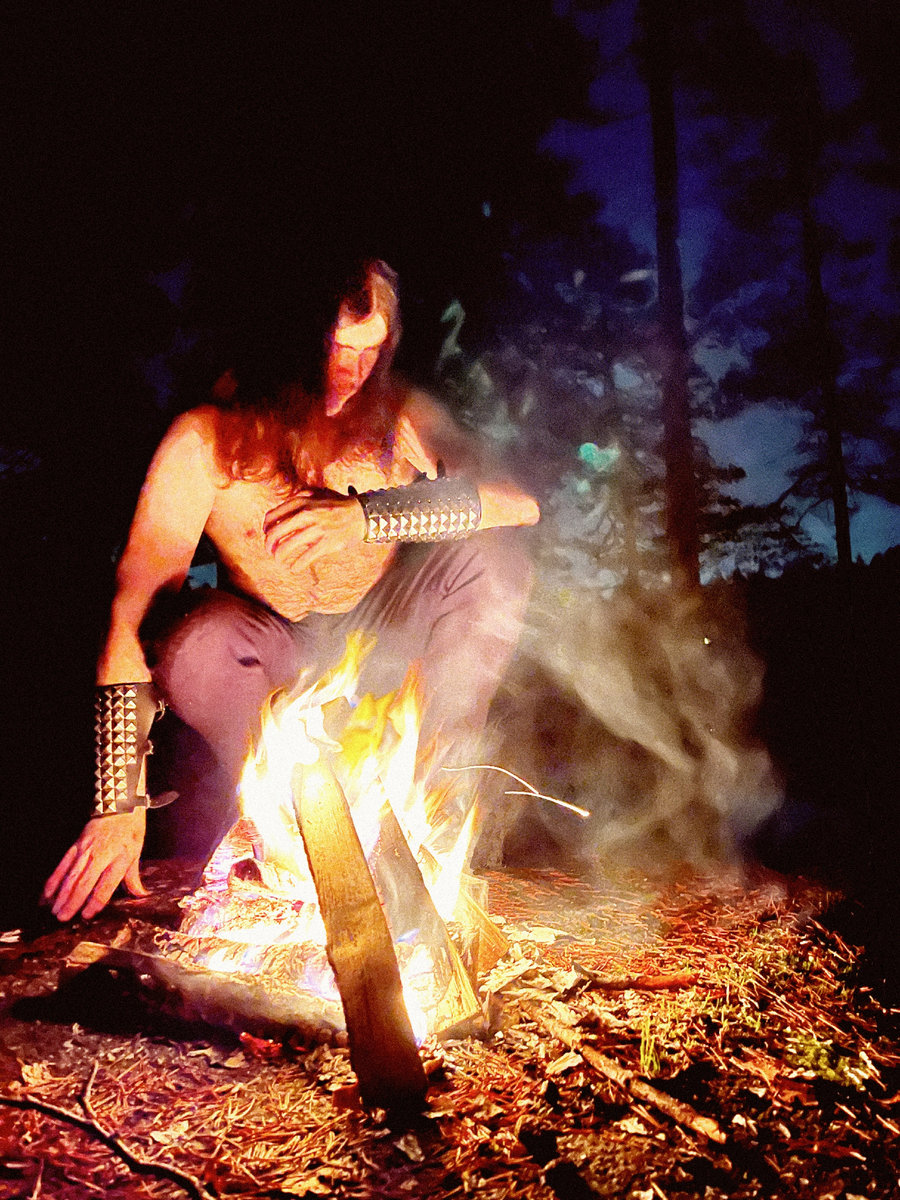
A Deep Exploration of Bronze Hall
I. Artistic Vision & Identity
Bronze Hall exists as a singular creative force under Yöpyöveli. What compelled you to undertake every facet of the music, from performance to production, alone?
Believe it or not, I have never even thought about it. To me Bronze Hall is very specific in sound. I think someone trying to help me could make it stray off its course.
The name Bronze Hall evokes age, fortitude, and myth. What guided your choice of this name, and what does it signify to you personally and artistically?
I will leave the name open to interpretation. It does evoke all those things. That is one of the reasons why I chose it.
Epic Black Metal can be a crowded field, yet your work feels immediately distinct. How would you describe Bronze Hall’s unique voice within the broader metal continuum?
The original goal of Bronze Hall was to take the style of epic metal with all its grandness, melody, story-telling and atmosphere, but which often sounds like plastic nowadays, and make it sound like a hammer hitting you in the face. I obviously draw great inspiration from the masters…Bathory, Isengard, Manowar, Candlemass etc etc.
In both “Honor & Steel” and “Embers of the Dawn”, there are sweeping shifts from rage to reflection. How conscious are you of pacing and emotional architecture when you compose?
Contrast and shifting dynamics are very important. For Bronze Hall, they can make a heavy part even more hard hitting or a quiet part resonate better. There definitely needs to be a balance, but ultimately, I’m not smart enough to actively think about these things…I think they come with intuition.
Do you see Bronze Hall as chronicling internal landscapes as much as external mythic ones; that is, do these Epic themes mirror inner emotional struggles?
Bronze Hall does not deal with personal struggles in any way. The themes are more universal. I view Bronze Hall, and all of my other projects totally separate from my personal life.
II. Themes, Storytelling & Poetic Universe
The track titles alone, such as “Ancient Whispers” and “Night’s Black Wings”, conjure imagery as vivid as any text. Do you approach your music as a form of poetry in sound?
I do actually try to conjure images or scenery with the music very consciously, so in a sense, yes. The lyrics are written after the music is done based on what the song sounds like translated to words. Usually it’s a specific season, landscape or a feeling that a song is based on. For example in “Embers of the Dawn”, most of the songs are set at a different time of the day. This was something that was not apparent while writing the songs, but when the songs were finished, they naturally fit this way when arranging the running order, so the album starts at the darkest hour of the night and ends in the sunlight’s embrace.
Epic Black Metal traditionally deals with battle, myth and heritage. Where do you feel Bronze Hall’s thematic roots lie, in personal experience, folklore, or something else entirely?
Bronze Hall is not directly about heritage, folklore, religion, spirituality or history. It’s more universal themes like death, strength, honor, fear, joy and nature. They are themes most throughout history could have related to. I tend to express these themes with the aid of story-telling.
“Land in Solitude (Quest for Blood)” spans over ten minutes. When you write Epic tracks of such scale, is narrative coherence or emotional continuity your primary guide?
I write the songs very intuitively with no lyrical narrative in mind. I think the most important thing is that the songs sound good, flow well and build and release tension when needed. But if all the riffs are solid, it is hard to not make it work. Of course there is a narrative in the music itself and in some songs it can be grand and long. And the long songs especially need to be coherent in musical narrative.
Your music moves fluidly between martial might and mourning hues. Do you view silence, atmosphere and texture as central ‘characters’ within your compositions?
I view textures and sounds as tools to get the point across. Sometimes I need a dense and crushing sound, sometimes grand and breathing. I do think Bronze Hall is very dependent on texture as opposed to playing something special, technical or sophisticated.
Is the “hall” in Bronze Hall a literal place, a metaphorical space, or something more ineffable, perhaps both physical and psychological?
This I cannot really answer. It’s for everyone to picture for themselves.
III. Creative Process & Sonic Alchemy
Walk us through your creative process: does a song begin with a melody, a theme, or a visceral emotional impulse?
Almost always the song starts with one riff or melody. And usually that one riff is the first one played in the song. For example, the first riff written for Bronze Hall ever, is the first riff of “Triumph of Honor & Steel” from the debut album “Honor & Steel”. The riff needs or motif needs to be strong enough for me to want to write a whole song out of it, and usually as soon as I have that first riff, I know how the rest of the song will go.
I do a lot of experimenting along the way and keep an open mind. Sometimes songs are written in hours, sometimes they take days and it has nothing to do with the length of the song.
Do you employ conceptual frameworks or narratives before writing, or does meaning emerge after the music has taken shape?
Sometimes I will have some themes or ideas in mind beforehand, but usually not. The framework and feeling of a song comes after that one glorious riff. I really try to make the music speak for itself. If I have to explain the song, then it has failed. The atmosphere and themes need to come across in the music itself and they are reimbursed in the lyrics after.
Your compositions balance forceful blast-leaning sections with sweeping, almost cinematic passages. How do you maintain cohesion between such contrasting elements?
There is no conscious method or guideline for me. It’s pure instinct. Nothing else to say.
What role do rhythm and pulse play in your sense of storytelling, is the beat itself a protagonist or an emotional compass?
I'm not entirely sure what it means, but the beat is very important for Bronze Halls music. I think the riff is the protagonist always, and the beat gives the riff its character and drives the song forward.
How has your approach to recording and mixing evolved between “Honor & Steel” and “Embers of the Dawn”, if at all?
"Honor & Steel" is more airy, majestic and glimmery in songwriting and sound, while "Embers of the Dawn" is heavier and darker. I wanted it to be deep, organic and crushing to emphasise on the songwriting style. I like how both of the records sound, and I think both records play to their strengths. I don't do things by the book for Bronze Hall when recording and mixing, because that is not how you get raw and heavy sound. You get it by putting all the knobs on max.
IV. Influences, Traditions & the Metal Universe
Epic Black Metal often draws comparisons to formative acts like Bathory. How do you relate to such lineage, as inspiration, influence, or something to transcend?
I am very inspired and influenced by many formative heavy metal and black metal bands. Quorthon was a visionary and one of the greatest songwriters in metal. Monumental inspiration and influence for Bronze Hall and all of my other projects as well. No one will ever transcend Bathory.
Do non-metal genres (classical, folk, ambient) play a role in shaping your work, consciously or subconsciously?
I listen to different kinds of music like everyone else. I would say it’s mostly subconscious. It never crosses my mind what genres influence me, even though it may be obvious in the music. If it sounds good then it sounds good.
How do you see the tension between tradition and innovation manifesting in your music? Is Bronze Hall a guardian of orthodoxy or an agent of evolution?
I make music based on my influences and what I like. I don’t think it’s innovative or guarding the old school. That being said, I definitely think Bronze Hall is an outlier from many current bands in a way that it’s not polished and is very rough around the edges. I record everything relatively fast without correcting the mistakes too much.
Finnish musical heritage is rich and diverse. Does local culture or myth inform your creative ethos in any direct way?
We have a lot of metal bands and other great music as well. Also history and culture that would serve as a good theme for a metal band, like Amorphis for example. Bronze Hall definitely has influence from both, the music and culture.
In a genre where community and collaboration are often celebrated, what do you see as the advantages, and challenges, of solo creation?
Honestly it’s not a challenge for me at all. I can see someone having trouble if they can’t play all the instruments they need or can't record. Of course it’s a lot more work. The advantage is that everything done is on my own terms.
V. Philosophy, Emotion & Transformation
Epic Black Metal can evoke grand narratives and existential reflection. Do you see your music as a journey outward into myth, inward into psyche, or inseparably both?
The first album was definitely more myth and swords, while the new one is more reflection by the fire. I see it as both at the same time. Everyone will interpret the music and its meaning in their own way, and I think that's the beauty of it. To some it's only riffs, to some it’s stories and to some it's something more and that's totally fine.
Does your work aim to confront listeners with struggle and triumph, or to provide a space of contemplation and emotional resonance?
I think it has the potential to do both. I don’t really think about who listens to Bronze Hall or how I want it to be perceived. I write the songs and lyrics so that they make sense to me and sound good to my ears.
Are there philosophical or literary frameworks that have shaped your worldview and, by extension, Bronze Hall’s lyrical imagination?
There are no defining frameworks for Bronze Hall. It’s not based on philosophy, politics or literature. If anything, it’s about being a human as corny as it may sound.
What does “steel” represent to you metaphorically, strength, resilience, inevitability, or something darker?
Steel represents all of those things. A weapon can mean strength, honor and a call to action. But it can also represent a bringer of death, horror and loss. It depends on the context.
If music could be distilled to a singular purpose, what would Bronze Hall’s be? To awaken, to challenge, or to transform?
I have never thought about it, but I think it has changed over the two releases and will continue to do so. Outside of the music, I think Bronze Hall can remind of things that are easy to forget in the modern world.
VI. Beyond the Music
If Bronze Hall were to be translated into a visual medium, film, graphic novel, installation… what would be its aesthetic?
If Bronze Hall was translated to a visual medium, it would be a Conan the Barbarian style movie.
Does your music have a ritual aspect to you personally, something you create for your own psychological and spiritual terrain?
I can’t picture myself not writing and recording music. I do the kind of music I myself like to listen to or play. That being said, after I release a project, I rarely listen to it. I almost instantaneously start to write new music and often I have many projects ongoing at the same time. It's all purely self expression to me.
Would you ever consider expanding Bronze Hall into a live project or collaborative ensemble, or is its solitary nature intrinsic to its identity?
I do not think Bronze Hall songs would translate live very easily. It would have to be in a certain setting for sure. Not saying it will never happen but time will tell. The same goes for collaboration. It’s hard to imagine anyone joining Bronze Hall creatively.
How do you wish Bronze Hall to be remembered, as a chronicle, a myth-making artefact, or a sonic beacon in the void?
I really do not think about these things, but if it were to be remembered for anything, I would want it to be for the good music.
Finally, what lies beyond the dawn you evoke, after embers fade and steel cools?
After the steel cools, it will be sharpened and Bronze Hall will stride towards new horizons.
IV. Parallel Projects — Forgotten Vale

Forgotten Vale feels markedly introspective and withdrawn in spirit. What artistic or emotional necessity led to the creation of this project alongside Bronze Hall?
The original demo “World of Endless Green” was my first solo output. I spent a fairly long time writing it even though it's only one track. I think you can hear that I did not know what I was doing in the mixing and recording department, but that gave it its own charm. It's raw, cold and almost soft sounding.
The new demo was semi-improvised during two days last summer. I recorded the drums first with my phone and played the riffs after. In the first demo I tried to compose a coherent song whereas in the new demo I wanted to conjure primal energy in its rawest form. So the two demos are very different and the project has evolved a lot after the almost 4-year gap.
The music often seems less concerned with movement and more with atmosphere and suspension. Do you approach Forgotten Vale as a form of inner dialogue — perhaps even as a private ritual?
I think in the current state of the project, private ritual is more accurate. The last demo was more concerned with the means of doing it rather than the outcome. I have had some ideas and thoughts of doing more thought-out songs.
How instinctive is the separation between projects when you compose? Do you immediately sense when an idea belongs to Forgotten Vale rather than Bronze Hall?
The two projects are almost from a different universe. There is very little in common between them sonically.
Forgotten Vale appears largely unmoored from concrete time or place. Is this an intentional act of abstraction, a way of stepping outside both scene and history?
The themes of Forgotten Vale are very much about nature, cosmos and its timelessness. The silence and grandeur of untouched wilderness. Forgotten Vale is not trying to achieve anything outside of the music, be a part of any scene in particular or pay homage or care about history.
Lyrically and conceptually, ambiguity seems central. What role does obscurity play for you as an expressive tool rather than a concealment?
Like I said before, I like for my music to speak for itself. I don’t try to necessarily conceal anything, but I don't like to spell things out. Most people, myself included, are there to listen to the music after all.
V. Parallel Projects - Houre

Houre, by contrast, feels sharper and more confrontational. What impulse or tension gave rise to this project?
Houre was created by me and Magus of Kaikkivaltias to create pure Finnish devilry from the Finnish woods.
The name itself carries a sense of urgency and fracture. How important is naming in defining the emotional and sonic direction of a band for you?
It's important to me and I do put thought into it. However, there are countless great bands that have a stupid name at face value and vice versa. So I don't think it matters as much as many like to think. Visual presentation is way more important in my opinion.
Does Houre function as an outlet for ideas that would feel restrained within Bronze Hall, or is it more of a distillation, stripping things down to their rawest form?
I have a lot of projects in addition to the 3 mentioned in this interview. Every one of them has its own character, style, influences and songwriting methods. I mentioned Forgotten Vale being semi-improvised and Bronze Hall more conventionally composed. Houre lands somewhere in the middle. I think spontaneous and experimental is the best way to describe Houre’s way of writing. Ideas come and go and we don’t plan all that much.
Houre seems grounded in physicality rather than atmosphere. Was this a deliberate reaction against abstraction, or simply a different emotional state demanding expression?
Houre is maybe the closest to pure black metal of all my projects. It’s meant to conjure the darkness of the woods and presence of evil. We wanted to create the kind of black metal that we both like to listen to. It's primarily based on the first and second wave masters like Celtic Frost, Bathory, Darkthrone, Armagedda, Rotting Christ, Necromantia, Judas Iscariot, Beherit among others. It’s a mixed bag of evil stuff.
How does collaboration — or its limits — shape Houre differently from your other work?
Houre has the output of Magus in addition to myself, so it will sound very different without a doubt. Like I said, to me Houre is the only one of the three projects mentioned that I can describe as black metal. We write songs individually and together and also both of us write lyrics and do vocals. On recordings I do the drums, synth and have done the bass in recent recordings. Magus handles the guitar, some synth and also handles the majority of the vocals.
VI. Multiplicity & Artistic Continuity
Taken together, Bronze Hall, Forgotten Vale, and Houre present a strikingly diverse body of work. Do you perceive these projects as separate identities, or as different facets of a single evolving self?
Yeah like I said before, they are all very individual. They are not really linked in any way other than by me doing them.
Is there a philosophical or emotional thread that connects them all, even if it is not immediately audible?
I think it’s that they are all related to nature and the Finnish woods in very different ways. Bronze Hall is more of the effect man has on nature and vice versa, Forgotten vale is worshipping it and Houre is about drinking in the forest while the devil is watching.
How do you guard against creative dilution when working across multiple projects, each with its own demands and internal logic?
They are all so different that it’s not hard for me. Each of them definitely has their own sound and logic. Also when doing many projects simultaneously, I usually put many on hold for a while if I am not inspired or motivated at the moment. It often also helps to distance oneself from a project and do something else entirely for a while to gain a new perspective.
In a cultural climate driven by constant output and visibility, what does it mean to you to allow certain projects to remain dormant until they truly need to speak?
I always release my music when it's ready to be released. I would never release or do something to stay relevant or anything like that. There is a lot of over-saturation in music due to how easy it is to make and release in this day and age. It's essential to focus on the artistic vision.
Ultimately, do these parallel projects serve as extensions of black metal’s expressive range, or as quiet acts of resistance against its conventions?
I am not concerned with expanding Black Metal, or its conventions. I will continue to do my music like before - without guidelines or dogmas.
Bronze Hall
Epic Black Metal as Modern Mythmaking
At a moment when Metal’s many offshoots often blur into one another, Bronze Hall stands out not by novelty alone, but by intent: a purposeful forging of music that resonates like incantation, myth and stark emotional panorama. Through “Honor & Steel” and “Embers of the Dawn”, Bronze Hall has signalled an artistic ethos that seeks both grandeur and intimacy, expansive soundscapes that still speak directly to the listener’s core.
What emerges is a compelling tension between visceral force and contemplative space, a dialectic that carries not just the power of metal but the weight of narrative, poetry and psychological depth. Bronze Hall’s work feels less like albums and more like archives of emotional and mythic experience, treasures unearthed from memory and imagination, then cast anew in fire and echo. In a scene where technology, trend and repetition often suffocate innovation, Bronze Hall prefers gravity, lineage and conquest of inner terrain. That choice, to pursue Epic vision in unfashionable solitude, may well be its ultimate triumph.
FORGOTTEN VALE OFFICIAL BANDCAMP
Comentários
Enviar um comentário