Ablazen Winds
“Kingsblood”
(Blud Auk, 2026)
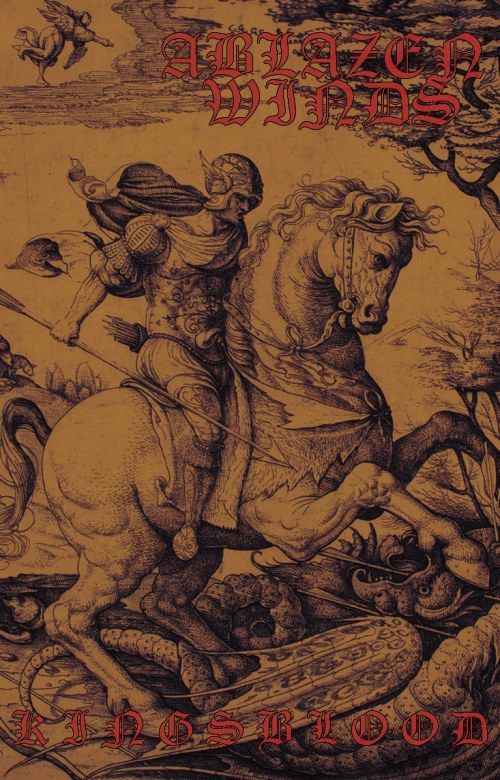
There are albums that roar into existence like tempests, obliterating expectation, and then there are those that enter like an ancient wind, invisible at first, yet inevitable in its force. “Kingsblood”, the new offering from Ablazen Winds, is the latter: a spectral procession of sound that unfolds like a myth unearthed, a tale told in frost and thunder, where every note feels as ancient as the bones of the earth itself. From its first breath, this record inhabits a world that is shrouded in mist and crowned by ruin, where the echoes of forgotten battles linger like ghosts carried on a cold, unrelenting wind.
Ablazen Winds approaches Black Metal not as mere aesthetic or genre shorthand, but as a medium for conjuring landscapes of psyche and spirit. In “Kingsblood”, the listener is not invited to simply listen, but to be drawn into a vast, mythic architecture of sound, a realm where time dilates and the boundaries between past and present, flesh and memory, begin to blur. The album opens with a rusted whisper of strings, like distant horns inhaling before a storm, and soon the music expands outward, vast and uncontainable, as though unleashed from some hidden horizon where sky and mountain converge.
There is a particular gravitas to the way Ablazen Winds structures their compositions. These are not songs that attack like sudden lightning; rather they are incantations that rise and fall with ancient cadence, each passage breathing into the next, forging a sense of inevitable motion. Melodies weave through storms of tremolo and thunderous rhythms, but never without purpose. Every motif feels deliberate, as if the album’s spine is carved from the bedrock of legend itself. It is music that resists the triviality of immediacy, choosing instead to unfold with the patience of epochs, to reward not the casual listener, but the pilgrim willing to traverse its breadth.
The production on “Kingsblood” reflects this vastness with crystalline clarity. The guitars cut through the mix like sharpened steel, their harmonies layered into dense, cathedral-like textures that resonate with both majesty and menace. Drums thunder beneath these walls of sound, not as mere percussion, but as primal heartbeat, a pulse that anchors the music’s grand sweep. Vocals emerge like voices carried from distant battlements, not so much sung as summoned, spectral narrators caught between worlds. There is a chilling spatial awareness here; every instrument inhabits its own domain, yet each serves the greater whole, and the result is an enveloping soundscape that feels as boundless as the sky.
Yet what makes “Kingsblood” truly remarkable is not merely its sonic architecture, but its evocative force as myth made audible. The title itself suggests lineage and sacrifice, the blood of rulers spilled upon the earth, seeding legend in its wake. And throughout the album, one senses this thematic current not as explicit narrative, but as a deep undercurrent, shaping the emotional terrain. There is a sense of ruin wrestled from memory, of empires breathed into myth, of winds that carry the weight of all that has been lost and all that might yet be reclaimed.
The record’s pacing is inexorable. It is not content to merely overwhelm; it guides. Moments of ferocity are balanced by passages of solemn reflection, where atmospheric interludes echo like hymns in a ruined temple. In these quieter spaces, the music reveals its depth, there is heart here, a kind of sorrow that is neither mournful nor triumphant, but ancient and knowing. In this sense, “Kingsblood” transcends the conventions of Black Metal and becomes something closer to experience itself: elemental, sprawling, and strangely human in its depths.
Listening to this album is like watching an old-world rise and fall in unconscious memory. It evokes landscapes forgotten by time, yet uncannily familiar, as if the listener has walked these plains in dreams half-remembered. There is a relentless honesty in the sound, a refusal to dilute the music’s power for comfort or ease. Instead, Ablazen Winds demands that the listener confront the immensity of the music, to not merely hear it, but to inhabit it.
“Kingsblood” stands as a testament to what Black Metal can achieve when
it embraces vision over trend, depth over spectacle. It is not an album made to
be grasped at once, nor is it interested in fleeting impact. Its greatness lies
in its ability to evoke a realm, a realm where the listener feels both
infinitesimal and essential; a realm where the wind itself seems to remember
the names of kings long turned to dust. In this sense, Ablazen Winds has not
merely crafted a collection of songs, but summoned a wind of ancient memory, a
myth heard as much as felt, carrying the listener across the threshold of sound
into something that feels like legend itself.
Comentários
Enviar um comentário