Angurvadal
“Winds of Jötunheimr” (Blud Auk, 2026)
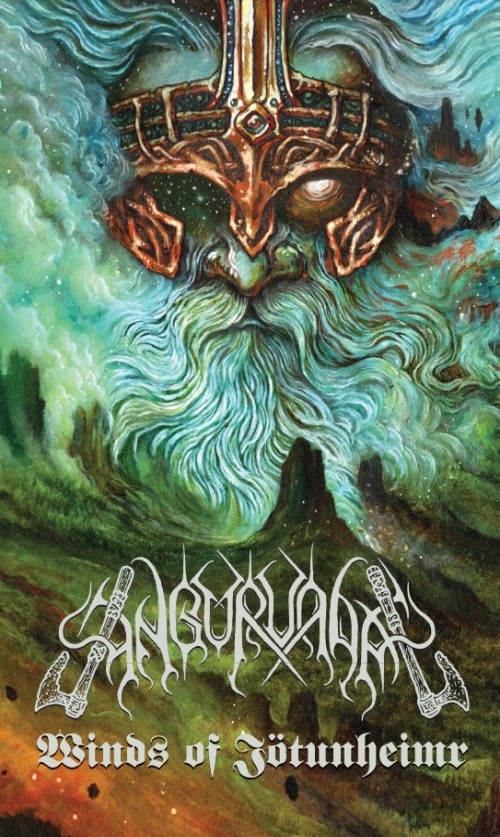
There are albums that emerge quietly, slipping like ghosts through the cracks of the underground, and then there are works like “Winds of Jötunheimr”, records that do not arrive so much as descend, vast and immovable, like glaciers grinding against the bones of the earth. With this 2026 release, Angurvadal does not simply participate in Black Metal’s evolving dialogue; it reclaims something ancient, primordial, an aesthetic lineage rooted in the mythic landscapes of Norse cosmology. Jötunheimr, the realm of giants, stands here not merely as a backdrop but as the axis of the album, a space of distance, hostility, and sublime scale where the listener feels both diminished and awe-struck.
From the very first moments, the album unfolds as a continuous atmospheric incantation. The guitars breathe and exhale harmonies that evoke frozen plains and towering, indifferent mountains. There is a deliberate pacing, a refusal to rush, as every note feels ritualistic in its placement. Angurvadal understands that immersion outweighs immediacy, that repetition becomes transcendence. The compositions expand gradually, layer by layer, building monolithic structures that demand patience and attention. Long-form tracks evolve with cyclical motifs and subtle transitions, creating not songs but topographies through which the listener moves, encountering frozen valleys of tremolo-picked sorrow, storms of blast-beat violence, and sudden clearings of haunting stillness.
The album’s mythopoetic resonance elevates it beyond mere stylistic execution. Jötunheimr is not used as a superficial aesthetic; it is invoked as a philosophical axis, a place where humanity dissolves beneath the weight of natural and cosmic scale. This is Black Metal in its purest conceptual form: anti-human, anti-modern, and profoundly existential, yet paradoxically intimate in its evocation of longing. The production mirrors this vision, striking a balance between rawness and clarity. Each instrument occupies its own frozen expanse, allowing the listener to navigate the sound as though traversing a vast, icy landscape. The drums cut like shards of ice, the guitars shimmer like distant auroras, and the vocals drift like spectral winds, echoing across these colossal soundscapes.
What becomes increasingly evident is the singularity of the album’s vision. This is music not created to impress but to exist. There is no pandering, no attempt to modernize or hybridize for accessibility; its power lies in its refusal to compromise. In a contemporary underground scene saturated with nostalgia and experimentation, “Winds of Jötunheimr” occupies a rare space. It is traditional without being derivative, atmospheric without stagnation, epic without excess. It resonates with the narrative immersion of myth-driven extreme metal while retaining a distinct identity, colder, more distant, and introspective, evoking landscapes rather than just emotions.
“Winds of Jötunheimr” is not an album that yields itself quickly. It demands patience, immersion, and surrender. For those willing to enter its frozen expanse, it offers something increasingly rare: a total world, not merely music, but environment; not just sound, but presence. In this sense, Angurvadal has not simply released an album; they have opened a gate to a place vast, indifferent, and endlessly compelling, a glacial masterwork that stands as a testament to Black Metal’s capacity for epic scale, mythic depth, and existential intensity.
Comentários
Enviar um comentário